The best thing you can do as a woman is to know and be familiar with how your breasts normally look and feel. Of course, breasts naturally change throughout life. During menstruation, pregnancy, breastfeeding, aging, and menopause. These life stages can affect the size, texture, and tenderness of your breasts.
A breast self-check can help you recognize changes, but you should know it does not substitute for a mammogram or medical assessment. Here’s how to check your breasts.
Step 1: Stand In Front of a Mirror.
Before you take a shower, stand in front of a mirror naked so you can see your breasts clearly. Stand with your arms relaxed at your sides. Look at the overall appearance of your breasts. Notice their usual size, shape, skin texture, and nipple position.
Look for any new swelling, dimpling, puckering, redness, skin thickening, or changes in the nipples. Remember that breasts do not have to be identical. Some asymmetry is normal. What matters is a change from your usual appearance.
Step 2: Raise Your Arms.
Lift both arms above your head and look at your breasts again. Check whether the skin pulls inward in a new way, whether one breast appears unusually swollen, or whether there are changes in the shape of your breasts or nipples.
You can also place your hands on your hips and gently press inward to tighten your chest muscles. Observe whether this reveals any new dimpling or changes.
Step 3: Check Your Nipples.
Look at both nipples and the surrounding darker skin known as the areola. Check for a nipple that has newly turned inward, a persistent rash, unusual scaling, sores, or fluid leaking without squeezing.
Bloody discharge or a new nipple change should be assessed by a healthcare professional.
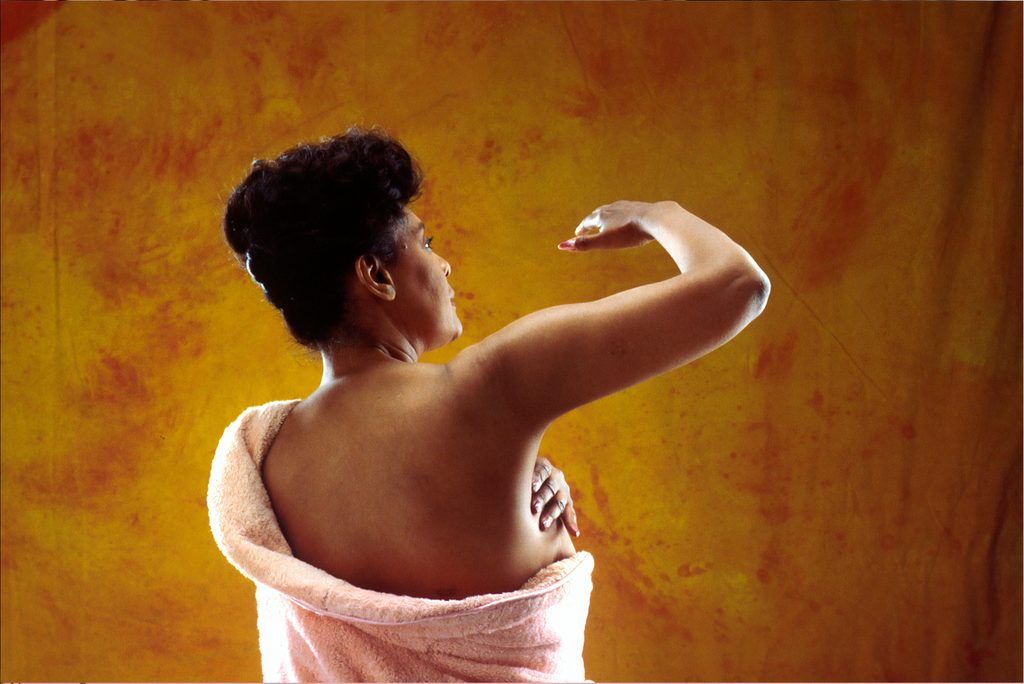
Step 4: Feel Your Breast Using the Pads of Your Fingers.
You can do this while lying down on a bed. It is a comfortable position that allows you to examine the entire breast.
Use the pads of your three middle fingers and not just your fingertips. Then apply gently, moderate, and firmer pressure to feel the different depths of the breast tissue.
Move your fingers in small circles or use an up-and-down pattern, covering the whole breast. Start near the collarbone and move down to the lower edge of the breast, then from the breastbone across to the side of the chest.
Pay attention to the area beneath your armpits, where lymph nodes are located. Repeat on the other breast.
You do not need to squeeze or pinch your breasts forcefully. The aim is to become familiar with your normal breast tissue, not to cause pain or bruising.
Step 5: Check For Changes Around the Armpits.
Gently feel the area beneath each armpit and notice whether there is any new lump or swelling. A lump in the armpit can have many causes, including infection and other non-cancerous conditions. However, a new lump should not be dismissed simply because it is not in the breast itself.
Step 6: Know When to Seek Medical Help
If you notice a new lump, unexplained swelling, skin dimpling, unusual discharge, or another persistent change, arrange a medical assessment immediately.
Don’t wait for the next self-check. Do not assume anything. Don’t assume that a painless lump is harmless or that it is cancerous.
A clinician may recommend an examination, ultrasound, mammogram, or biopsy, depending on your age, symptoms, and findings.
Please note: There is no single breast self-check technique that can reliably rule out cancer. A normal self-check does not guarantee that you are cancer-free. It just helps you notice any anomalies early enough.
Early Detection: Why Timing Matters?
Breast cancer can often be treated more effectively when it is diagnosed before it has grown extensively or spread to other parts of the body. Also, early diagnosis can expand treatment options, although the outcome depends on the cancer’s type, stage, and other individual factors.
If you know your breast well enough and notice something different, seeking medical attention can help reduce diagnostic delays. Also, screening is intended to identify cancer in people who don’t have any symptoms. ♥
Can breast cancer be prevented? Check our next article.
Photo by National Cancer Institute on Unsplash.

Mourine Warui is a media and communication expert and seasoned writer. Her goal is to empower and offer solutions to everyday girl’s problems while provoking candid and authentic conversations. Other goals are to provide inspiration and entertainment to readers through creative, thought-provoking and edgy stories.